
Technical insight
Before you use video embedding models
9 Nov 2026
- Video embeddings
- Evaluation
- Multimodal search
Type a scene into a search box and jump to the right few seconds of video. That is an appealing starting point for a media library, a training archive or a collection of product demonstrations. Video embeddings make that kind of search possible by putting clips and text into a shared numerical space.
The difficult part starts when you try to explain the results. What does a high similarity score mean? Can the same vector identify what is visible? Does a model that accepts video understand the order of events?
We built embedding-lens to inspect those questions. It compares three models on short clips and lets you change the vocabulary, readout method and second-stage ranking. The experiment produced useful results, including several reasons to be careful with an apparently convincing demo.
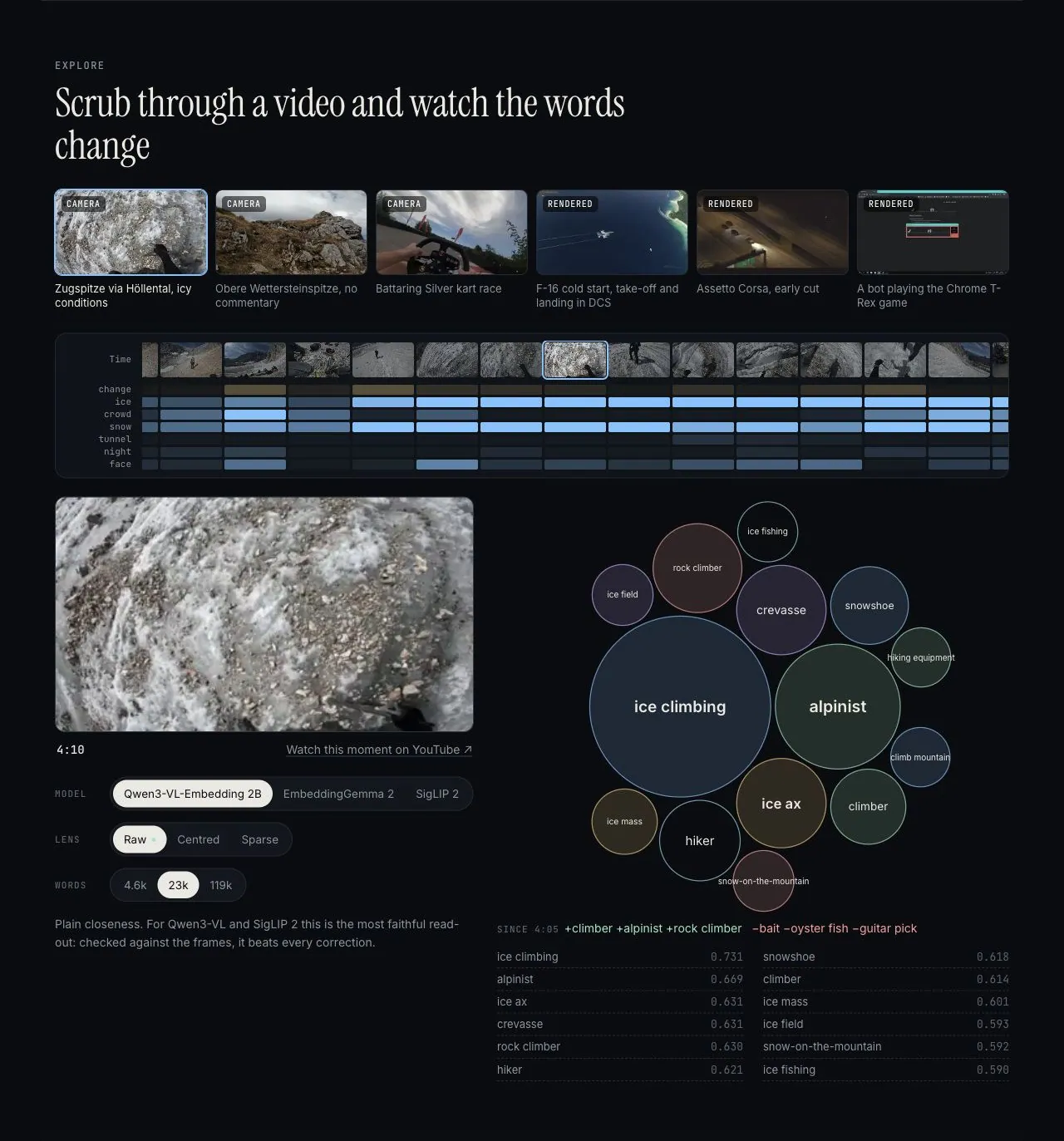
The running demo, using Qwen3-VL-Embedding 2B and 22,985 candidate phrases. The bubble positions are a packed layout; distance between bubbles does not represent semantic distance.
Decide what a correct result means
Finding the right clip and describing it accurately are separate tasks.
For search, you might ask whether a useful moment appears in the first five results. For an automatic label, you need to ask whether the named object, activity or setting is actually supported by the footage. A phrase can help identify a particular clip without being a faithful description of it.
That distinction mattered in our experiment. We tested a round trip: take the phrases closest to a video moment, embed those phrases as text, and check whether they retrieve the original moment. Across 36 model, vocabulary and readout configurations, the rank correlation between round-trip recall@5 and judged phrase correctness was approximately −0.60.
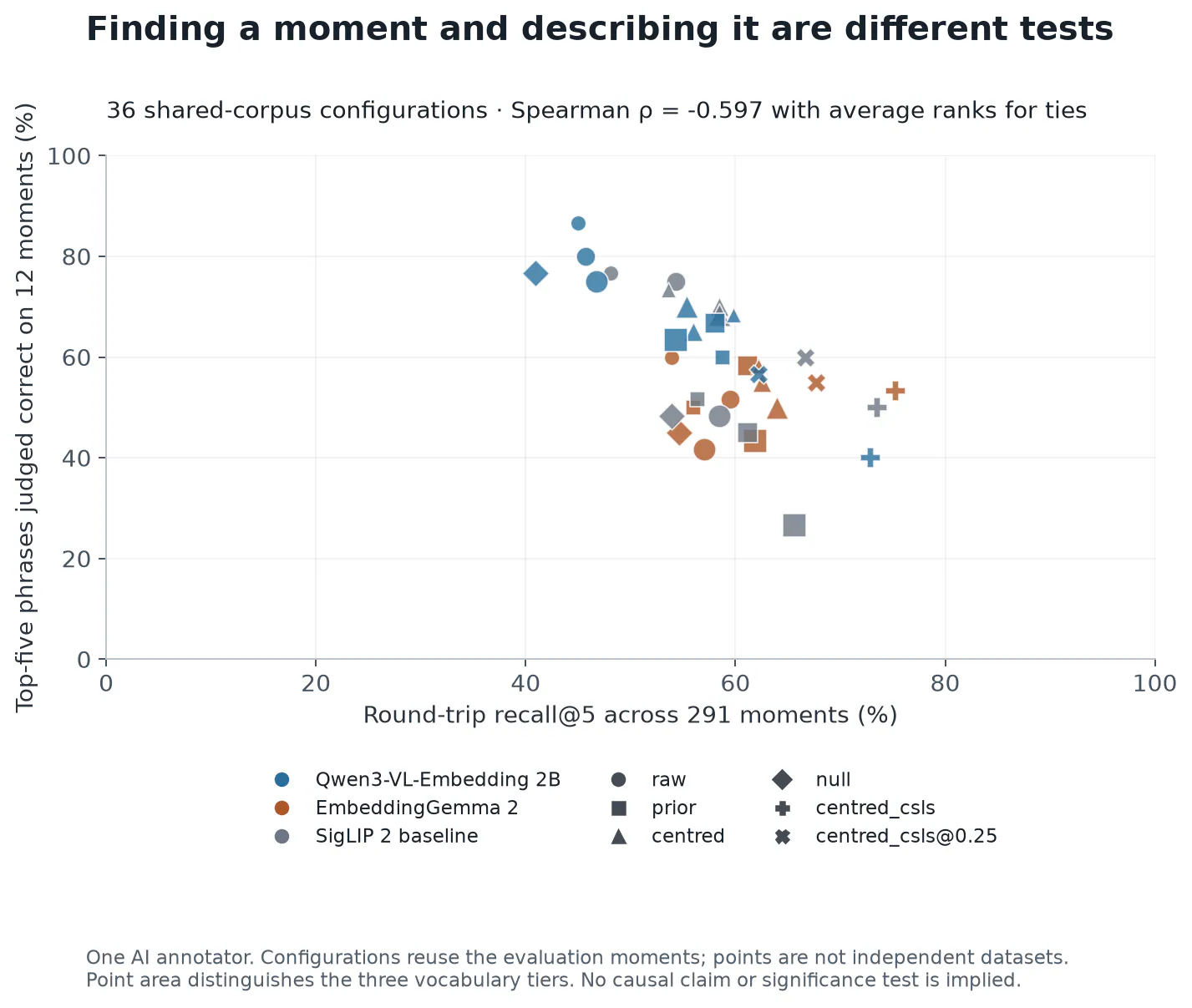
Each point is one configuration. Retrieval was measured over the original 291 moments; phrase correctness was evaluated on 12 shared moments by one AI annotator. The correlation uses average ranks for ties. These points are not independent datasets. Underlying table.
This result does not make retrieval metrics useless. It shows why a retrieval metric cannot, on its own, validate the accuracy of a description. If your product needs both, evaluate both.
Check what the model actually receives
A five-second window does not necessarily mean five seconds of information reached the model.
Our Qwen wrapper passes ten frames in order. The EmbeddingGemma 2 wrapper uses a clip file and its one-frame-per-second default. The SigLIP 2 baseline embeds individual frames and averages them. Those are different input paths, with different opportunities to miss an event.
A frame average cannot distinguish a sequence from the same frames in reverse. A native video interface gives a model the opportunity to use order, but useful temporal discrimination still needs testing. In our reversal experiment, the two native video models remained at roughly 0.98 cosine similarity to their original clips. The small take-off and landing probe provided a more relevant check of whether the changed order affected the language match.
For a product that searches for “a machine after the guard opens”, build examples where the order matters. Compare opening with closing, entering with leaving, or a step performed before and after another. Ordinary landscape queries will not expose the same weakness.
Keep frame rate, clip duration, resolution and input handling with your evaluation results. Otherwise a comparison between models can quietly become a comparison between sampling choices.
Give the vocabulary a job
Reading an embedding out as words requires candidate words. That list is part of the system you are evaluating.
We used nested vocabularies of 4,585, 22,985 and 118,979 phrases. With raw cosine ranking, Qwen’s share of top-five phrases judged correct went from 86.7% on the smallest list to 75.0% on the largest. SigLIP’s went from 76.7% to 48.3%. These percentages come from the same small annotation sample, rather than a broad tagging benchmark.
A larger list gives the system more ways to name something useful. It also gives an obscure near-match more opportunities to outrank an ordinary description. For an application with known categories, start with the categories people actually need. Add specificity when it improves a measured task.
Also distinguish fixed-vocabulary labelling from free-text search. A label absent from the candidate list cannot appear in a readout, while a search query can be embedded separately. The limits of one feature do not automatically apply to the other.
Treat calibration as an experiment
Centring subtracts a modality’s mean vector before comparison. It is a reasonable way to investigate a shared offset in the embedding space. It is also an intervention that can change which phrases win.
At the medium vocabulary size, our recorded results looked like this:
| Model | Raw readout | Centred readout |
|---|---|---|
| Qwen3-VL-Embedding 2B | 80.0% | 65.0% |
| EmbeddingGemma 2 | 51.7% | 55.0% |
| SigLIP 2 baseline | 75.0% | 70.0% |
Share of top-five phrases judged correct on 12 moments. Recorded scores.
That table supports testing centring in this setup. It does not establish a universal rule that a particular model always needs it, or that a large mean cosine is enough to choose a correction. The reference corpus, vocabulary and task can change the result.
The modality gap and sparse concept explanations have substantial prior research. Our contribution here is an inspectable implementation and comparison on video examples.
Account for the reranker separately
An embedding retrieves candidates cheaply after indexing. A reranker looks more closely at a smaller candidate set.
Our reranker reads the original video together with each candidate phrase. At 22,985 words, the recorded share of correct top-five phrases rose from 80.0% to 93.3% for the Qwen first stage and from 55.0% to 88.3% for the centred EmbeddingGemma first stage.
The extra inspection is important to the interpretation: this stage adds evidence from the footage. Its output is not an explanation recovered from the original vector alone. Reranker-only phrases were also annotated afterwards by the same AI judge, with their origin known, so the exact gains need independent confirmation.
If you include a reranker in a model comparison, record its latency and evaluate the whole pipeline. A useful first stage might be the one that reliably includes the right answer in its candidate pool, even if its first-ranked answer is weaker.
Separate indexing time from search time
Downloading a model, processing a library, embedding a new query and reranking results are different costs.
The demo precomputes segment vectors and several queries. Free-text search needs an available backend; reranking requires another model pass. A page that responds instantly to a precomputed example has not demonstrated the latency of those live operations.
Measure them individually on your intended hardware. Include cold starts, concurrent requests and the fallback when a model service is unavailable. Those measurements tell you more about the interface you can offer than a single throughput number.
Build a small evaluation you can inspect
Start with actual questions and footage from the intended use case. Include successful examples, plausible wrong matches, missing answers and events whose order matters. Define what a reviewer should mark as relevant before tuning the model or the correction.
Keep a separate set of source videos for checking the final choice. Neighbouring windows from one video share content; treating every window as independent can make the evidence look broader than it is. If an AI judge helps with annotation, retain its instructions and output, and have people check consequential decisions.
Our study used six source videos and 291 original moments. Phrase correctness came from 12 moments, half from one source video, judged by Claude. The public demo currently exposes 289 moments. These are exploratory engineering results, useful for forming tests rather than choosing a universal winner.
You can try the controls in the demo, then inspect the code and reproduce the experiments on GitHub. The useful next step is to apply the same questions to your own footage.
At Balta Tech, this is the kind of evaluation we use to turn an interesting AI capability into a system with a clear purpose and understandable limits.
Continue the research
Read the model comparison for the other side of the evaluation.