
Technical insight
Qwen3-VL-Embedding vs EmbeddingGemma 2 for video
9 Nov 2026
- Video embeddings
- Qwen3-VL
- EmbeddingGemma 2
For the phrase readouts in our video experiment, Qwen3-VL-Embedding 2B was the stronger first stage. EmbeddingGemma 2 processed text faster in our indexing runs and used a shorter output vector. Once a reranker examined the footage, the quality gap became smaller.
Those findings describe a particular system: a vocabulary of candidate phrases read against short video windows. They do not establish the best model for every kind of video search.
This comparison explains the measurements and the choices behind them. You can also switch between both models in the working demo.
The models and the input paths
| Qwen3-VL-Embedding 2B | EmbeddingGemma 2 | |
|---|---|---|
| Documented total parameters | 2B | 740M |
| Output width used here | 2,048 | 768 |
| Input used in this project | Ten ordered frames per moment | A video clip file |
| Sampling in this project | 2 frames per second | 1 frame per second |
| Inference precision used here | bfloat16 | bfloat16 |
The Qwen model card documents text and visual inputs. The EmbeddingGemma 2 model card also documents audio support. Our experiment evaluates video–text readouts; it does not compare audio retrieval.
The differing sampling paths matter. These are results for the implemented configurations, rather than a controlled comparison in which every preprocessing choice was matched. Both wrappers ran on an Apple M3 Pro laptop with 18 GB of memory.
Qwen produced more supported phrases in the small evaluation
We cut six videos into 291 five-second moments and compared their vectors against candidate vocabularies. For 12 selected moments, Claude judged whether each output phrase named something visible, the activity or the setting. Six of those moments came from the same video.
With the medium vocabulary, each configuration contributed 60 phrase positions: five phrases for each of 12 moments. The recorded results were:
| Readout | Qwen3-VL-Embedding 2B | EmbeddingGemma 2 |
|---|---|---|
| Raw cosine | 80.0% | 51.7% |
| Centred | 65.0% | 55.0% |
| Phrase prior | 66.7% | 58.3% |
| Sparse decomposition | 35.0% | 33.3% |
Share of top-five phrases judged correct, not a probability of correctness for a new clip. Source scores.
Qwen’s raw readout was the strongest of these choices. EmbeddingGemma improved with some corrections, although the gain from centring was modest and the phrase prior scored higher on this sample. Calling one correction “the best” without specifying the setting would hide that distinction.
The difference is visible on individual moments
For the Chrome T-Rex game at 0:50, Qwen’s raw top phrases included “computer screen”, “interface” and “screenshot”. EmbeddingGemma’s raw list began with “net”, “mew”, “emu” and “bug”. Centring changed its list toward terms associated with computers, but did not turn it into an accurate caption.
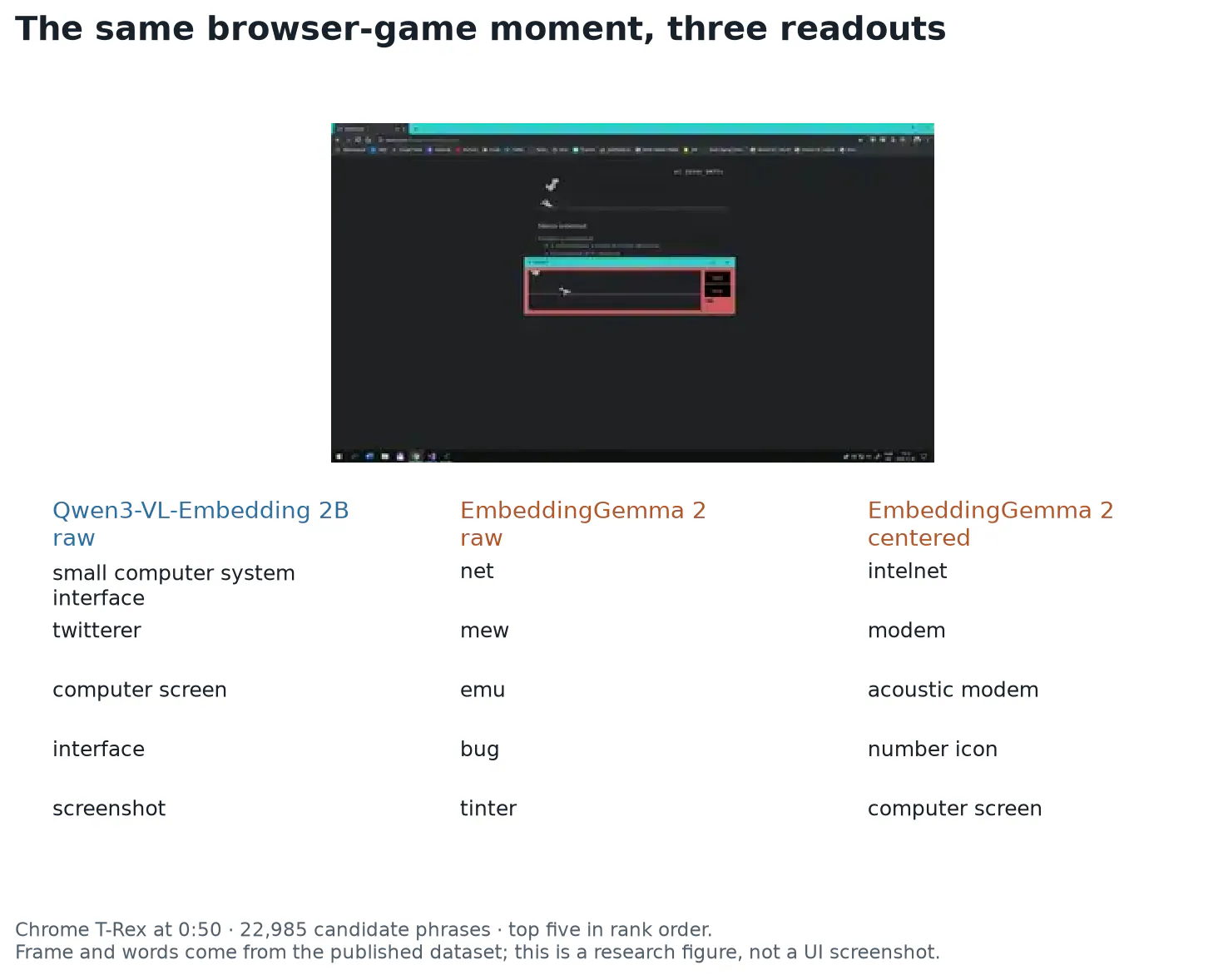
The same published moment and medium vocabulary. This figure reproduces the stored phrase lists. It illustrates a failure mode; the aggregate table is a broader view of this small sample.
To inspect it yourself, choose the Chrome T-Rex video in Explore, select 0:50 and 23k words, then change the model and lens. The separate ranked list keeps the exact phrases and scores visible.
Vocabulary size changes the comparison
The strongest model still has to select from the words it is offered. A broad list creates more chances for an obscure phrase to rank highly.
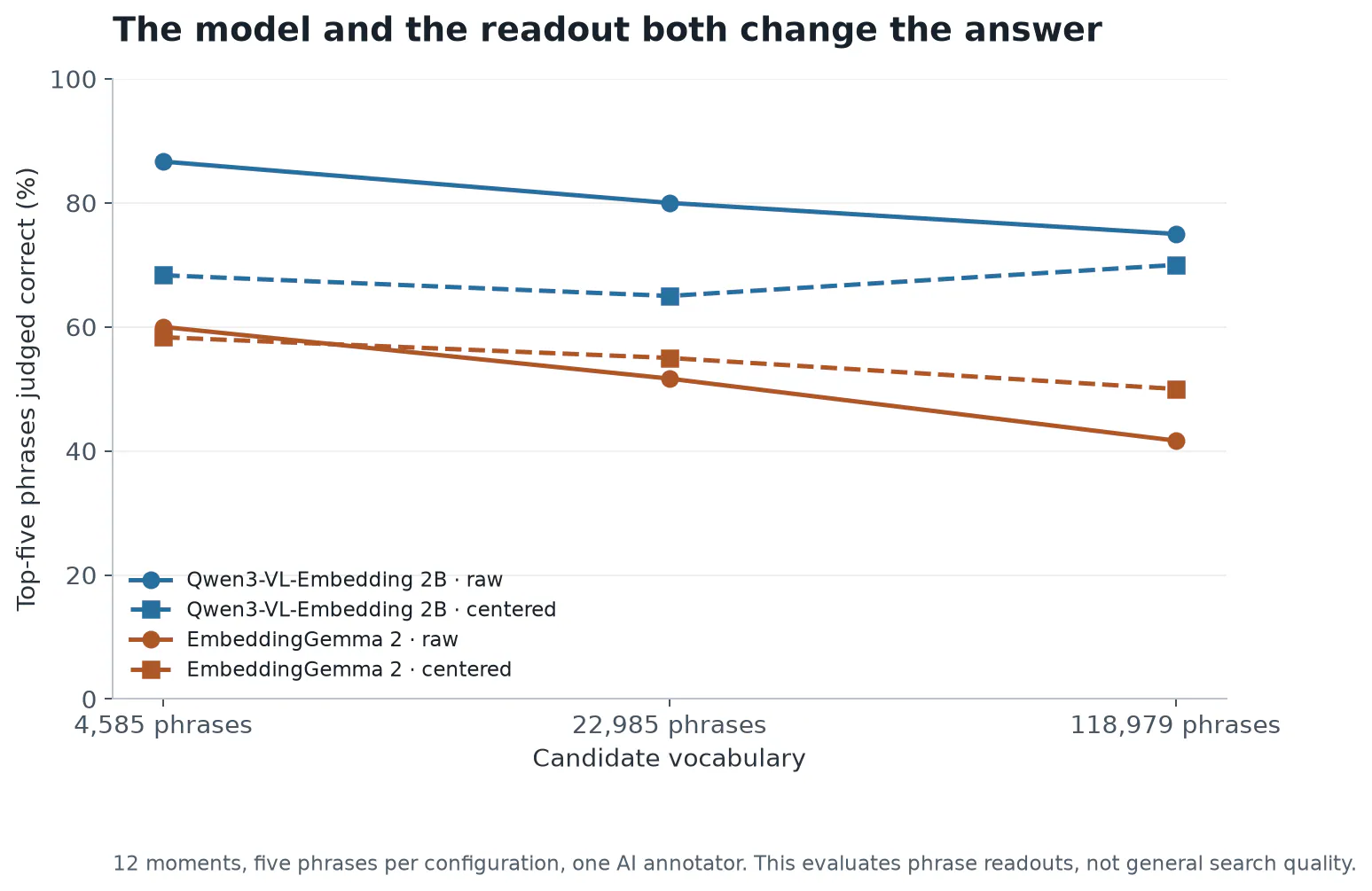
Each line uses the same 12 annotated moments. Raw and centred results are shown for both models so the comparison does not conceal the effect of the readout method.
Qwen’s raw results declined from 86.7% on 4,585 phrases to 75.0% on 118,979 phrases. EmbeddingGemma’s raw results declined from 60.0% to 41.7%; its centred results were 58.3% and 50.0% at those endpoints.
That makes a curated vocabulary a meaningful design choice for labelling. It does not mean a search product should reject every long or unusual query. Candidate labelling and arbitrary query retrieval need their own evaluation.
EmbeddingGemma was faster in our indexing logs
The recorded text rates were approximately 38 phrases per second for Qwen and 363 for EmbeddingGemma. Recorded segment rates were 0.3 and 0.7 moments per second respectively. SigLIP 2, our averaged-frame baseline, processed about five moments per second.
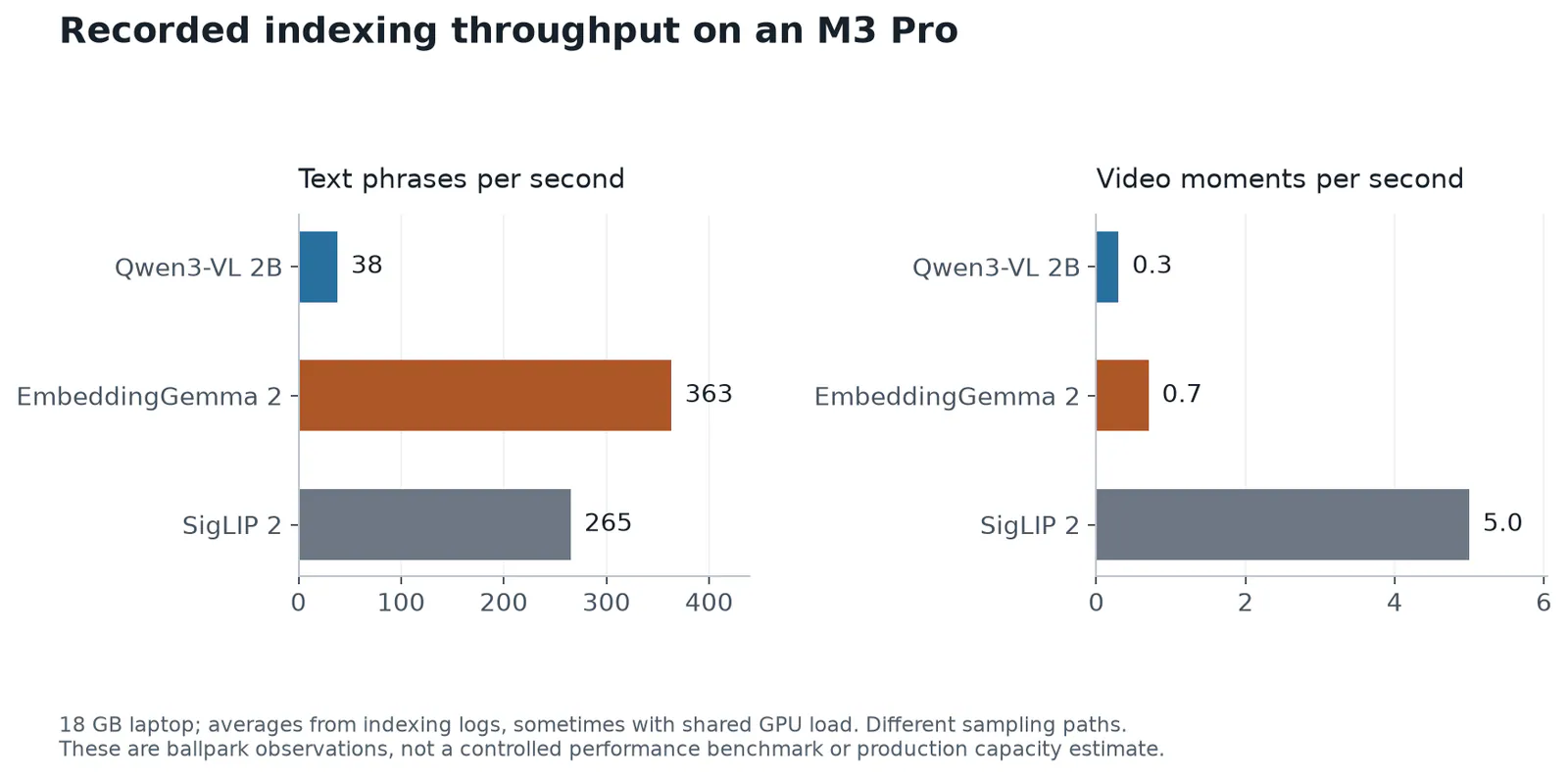
M3 Pro, 18 GB. The figures come from indexing logs, sometimes with other jobs sharing the GPU, and use different video sampling paths. They are ballpark observations rather than a controlled performance benchmark. Recorded rates.
These rates help explain the development experience. They cannot predict concurrent serving capacity, cold-start latency or a result on a different GPU. The phrase rates also describe indexing batches, rather than the response time for one interactive query.
Reranking changes the system you are choosing
We also retrieved candidate phrases and asked Qwen3-VL-Reranker 2B to examine each phrase together with the original video.
| First stage and vocabulary | Before reranking | After reranking the top 50 |
|---|---|---|
| Qwen raw, 22,985 phrases | 80.0% | 93.3% |
| EmbeddingGemma centred, 22,985 phrases | 55.0% | 88.3% |
| Qwen raw, 118,979 phrases | 75.0% | 90.0% |
| EmbeddingGemma centred, 118,979 phrases | 50.0% | 83.3% |
Same phrase-correctness task. Reranker-only phrases were judged after the initial annotation, by the same AI annotator with their origin known. The exact improvements need independent confirmation. Recorded reranking results.
The reranker adds another model and another look at the footage. Its gains do not show that the first-stage vector already contained a faithful explanation. In the medium-vocabulary runs, the recorded second-stage processing time was roughly 4.9 seconds per moment for Qwen candidates and 3.2 seconds for EmbeddingGemma candidates. Those are particular measured runs, not a claim that the first stage determines reranker speed.
If a product can afford that second stage, compare candidate recall and complete-pipeline latency. If it needs immediate readouts with no second inspection, the first-stage results deserve more weight.
How I would use this comparison
For the current embedding-lens phrase readout, I would begin with Qwen3-VL-Embedding 2B and raw cosine, then verify the result on held-out footage. That is the configuration our small evaluation supports most clearly.
I would evaluate EmbeddingGemma 2 when a compact model, broader modality support or a smaller vector payload changes the deployment requirements. The correction and candidate stage would need evaluation alongside it. A smaller model can be a useful component without matching a larger model’s first-ranked phrases.
I would keep the SigLIP baseline in the test. Its medium-vocabulary raw phrase score was 75.0%, close enough to Qwen’s 80.0% to make its much faster recorded indexing path worth understanding. An application that needs temporal reasoning would require a separate temporal evaluation, since frame averaging cannot encode order.
Before choosing between the models, match sampling where practical, use footage from the intended task, retain a held-out set of source videos and evaluate with people independent of the tuning process. The right answer may differ for retrieval, category labels and captions.
The interactive demo makes these differences visible. The GitHub repository contains the wrappers, judgements, experiment code and recorded outputs. For a production use case, Balta Tech’s data and AI work starts with the task and its evaluation requirements.
Continue the research
Read the practical guide before using video embeddings for the other side of the evaluation.